1528+
MWp Capacity435+
Projects1528+
MWp Capacity435+
Projects1528+
MWp Capacity435+
Projects1528+
MWp Capacity435+
Projects
1528+
MWp Capacity435+
Projects1528+
MWp Capacity435+
Projects1528+
MWp Capacity435+
Projects1528+
MWp Capacity435+
Projects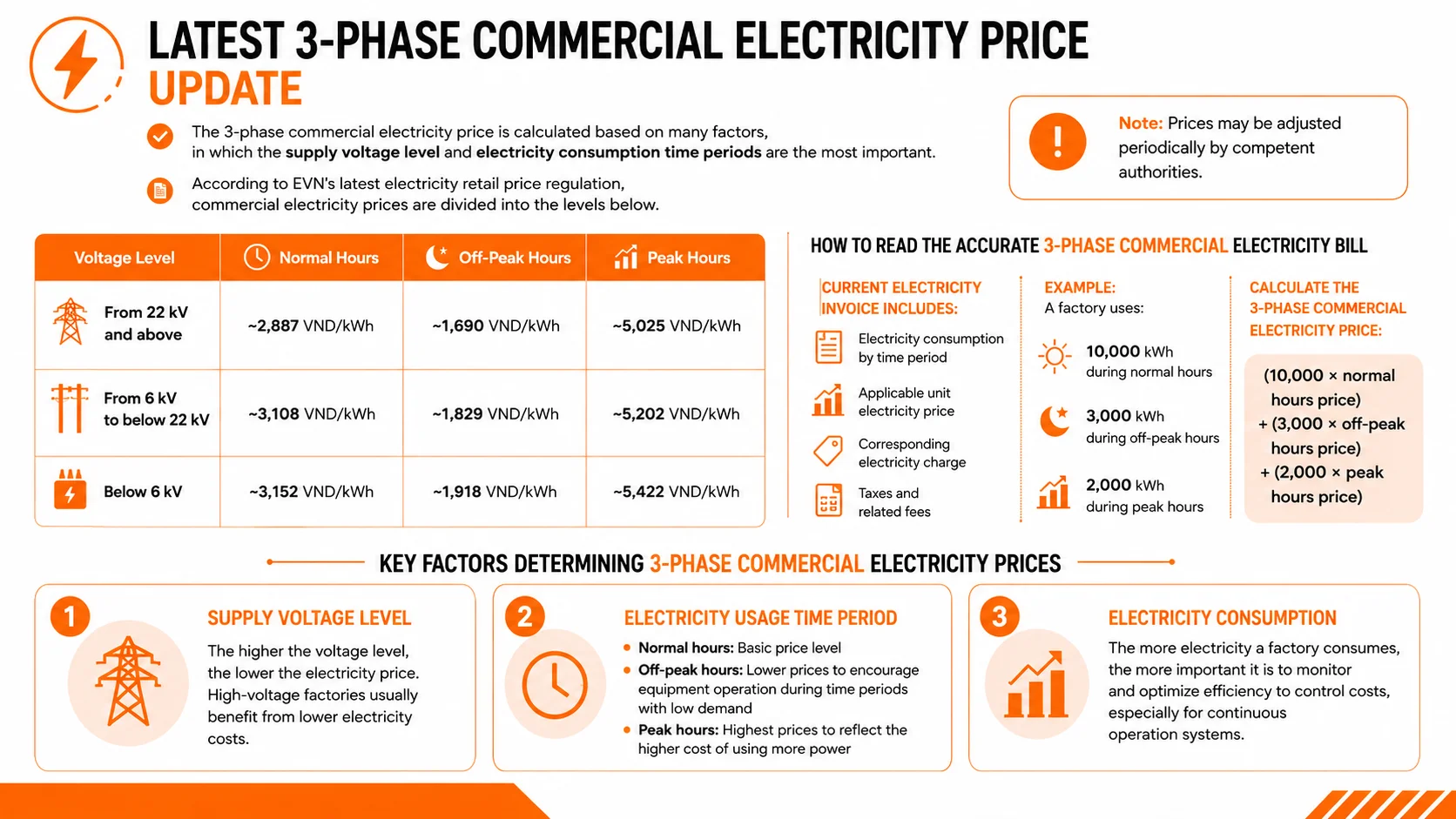
The 3-phase commercial electricity tariff in Vietnam is structured around voltage level and time-of-use billing, which means your monthly electricity bill is not fixed. It shifts based on when and how much power your facility draws. Understanding this structure is the first step toward meaningful cost control.
Commercial electricity covers power consumption used for trade, services, sales operations, and commercial facility management. Unlike residential electricity, which serves household needs, commercial power accounts for higher load volumes and is billed under a dedicated tariff framework based on supply voltage and consumption timing.
For industrial premises and mixed-use facilities, 3-phase commercial electricity typically applies to service zones, office areas, warehouses, showrooms, and hybrid production-retail operations.
| Category | Commercial | Industrial | Residential |
|---|---|---|---|
| Purpose | Trade, services, commercial operations | Manufacturing, processing, fabrication | Household use |
| Users | Offices, hotels, retail stores, shopping centers | Factories, production facilities, industrial zones | Households, apartments |
| Typical loads | HVAC, lighting, service equipment | Industrial machinery, production lines | Home appliances |
Common sectors operating under the commercial electricity tariff include:
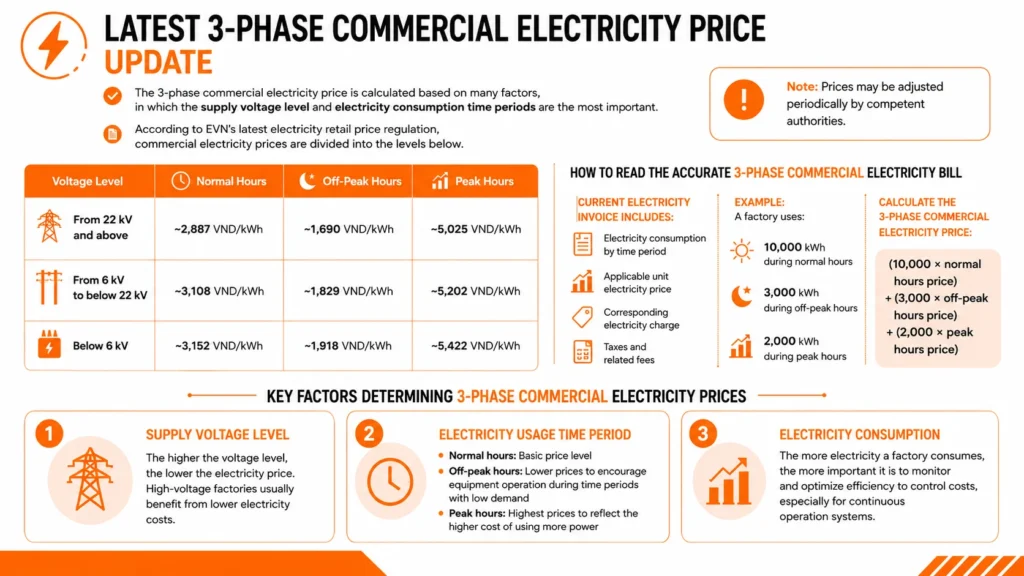
The commercial electricity tariff is determined by two primary variables: supply voltage level and time-of-use period. Under the most recent EVN tariff schedule, rates are structured as follows:
| Voltage Level | Normal Hours | Off-Peak Hours | Peak Hours |
|---|---|---|---|
| 22 kV and above | ~2,887 VND/kWh | ~1,690 VND/kWh | ~5,025 VND/kWh |
| 6 kV to below 22 kV | ~3,108 VND/kWh | ~1,829 VND/kWh | ~5,202 VND/kWh |
| Below 6 kV | ~3,152 VND/kWh | ~1,918 VND/kWh | ~5,422 VND/kWh |
Note: Tariff figures are subject to adjustment in line with periodic pricing reviews by the regulatory authority.
Supply voltage level: Higher voltage supply generally corresponds to lower unit rates. Facilities with large power loads often connect at medium voltage to reduce per-kWh costs.
Time-of-use period: Vietnam applies a three-tier time-of-use billing structure:
Total consumption volume: The more electricity a facility consumes, the greater the financial impact of inefficiency. Continuous-operation machinery, in particular, demands close monitoring.
A standard commercial electricity bill itemizes consumption by time-of-use period, the applicable unit rate for each period, and applicable taxes and surcharges. The calculation follows this structure:
Total bill = (Normal-hour consumption x normal rate) + (Off-peak consumption x off-peak rate) + (Peak-hour consumption x peak rate) + taxes and fees
For example, a facility consuming 10,000 kWh in normal hours, 3,000 kWh off-peak, and 2,000 kWh during peak periods would be billed across all three tiers accordingly. Peak-hour consumption, even at a fraction of total volume, can account for a disproportionate share of the total bill.
The average electricity selling price is a weighted baseline figure calculated from the total cost of electricity generation, transmission, and distribution relative to total consumption within a defined period. This figure serves as the reference point for regulatory reviews and tariff adjustments.
Tariff adjustments are driven by cost movements in several areas:
For facilities with large power consumption, each tariff increase translates directly into higher operating costs. When electricity is a significant line item in OPEX, even a modest rate adjustment can materially impact product pricing and margin. This is why energy cost management has become a core component of asset operations strategy, not just a facilities concern.
Reducing exposure to a high commercial electricity tariff requires a structured approach rather than one-off interventions. Practical measures include:
Beyond operational adjustments, a growing number of commercial and industrial asset owners are integrating rooftop solar to directly reduce grid electricity purchases. This approach shifts a portion of daytime consumption to self-generated power, providing a structural hedge against future tariff increases.
As a full-scope EPC contractor, Electric Bird delivers rooftop solar solutions for C&I clients, with a particular focus on office buildings, hotels, shopping centers, and commercial service facilities. The engagement model covers the full project lifecycle: site assessment, technical design, procurement, and system installation.

Beyond installation, Electric Bird’s Solar O&M service provides ongoing asset management support, including:
For asset owners seeking to reduce their commercial electricity tariff burden and build a more resilient energy cost structure, contact Electric Bird for a consultation on rooftop solar and Solar O&M solutions tailored to your facility’s load profile.
The bill is calculated by multiplying consumption in each time-of-use period by the applicable unit rate, then summing across all periods and adding taxes and fees: Total = (kWh per period x rate per period) + applicable charges.
Common causes include running high-load equipment during peak hours, aging equipment with reduced efficiency, and increased operational throughput. Tariff rate adjustments by the regulator can also contribute to bill increases independent of consumption changes.
Yes. Operational measures such as load shifting, off-peak scheduling, and real-time energy monitoring can reduce peak-hour consumption. For long-term cost reduction, integrating a rooftop solar system lowers the volume of electricity purchased from the grid at tariff rates.
Hotels, restaurants, retail stores, shopping centers, offices, logistics warehouses, and service facilities with significant electricity demand are typically classified under the commercial tariff category.
Yes. Higher voltage supply levels carry lower unit rates under Vietnam’s EVN tariff structure. Facilities with substantial load capacity may qualify for a medium-voltage connection, which can reduce the effective per-kWh cost.


For industrial facilities in Vietnam, electricity is one of the largest recurring operational expenses, especially for production lines running around the clock. Understanding how the Vietnam industrial electricity tariff is structured allows factory managers and asset owners to control costs, optimize production scheduling, and make informed decisions about energy investments. The short answer: your monthly […]

Understanding peak electrical hours is a practical advantage for any facility manager or business owner. Knowing exactly when demand spikes allows operations teams to reschedule high-draw equipment, reduce strain on the grid, and meaningfully cut monthly energy costs over the long term. What Are Peak Electrical Hours and When Do They Occur? Peak electrical hours […]

With rising electricity costs and growing pressure to meet sustainability targets, more factories and businesses are turning to solar as a practical solution. Understanding the full pros and cons of solar energy helps decision-makers invest with clarity, not guesswork. The Key Advantages of Solar Energy for Businesses The pros and cons of solar energy are […]