1528+
MWp Capacity435+
Projects1528+
MWp Capacity435+
Projects1528+
MWp Capacity435+
Projects1528+
MWp Capacity435+
Projects
1528+
MWp Capacity435+
Projects1528+
MWp Capacity435+
Projects1528+
MWp Capacity435+
Projects1528+
MWp Capacity435+
Projects
For industrial facilities in Vietnam, electricity is one of the largest recurring operational expenses, especially for production lines running around the clock.
Understanding how the Vietnam industrial electricity tariff is structured allows factory managers and asset owners to control costs, optimize production scheduling, and make informed decisions about energy investments.
The short answer: your monthly electricity bill is determined by how many kWh you consume, at what voltage level your facility operates, and which time-of-use slots your machines run in. Shift more load to off-peak hours, and the savings can reach hundreds of millions of VND per month.
The Vietnam industrial electricity tariff refers to the pricing structure that businesses pay for electricity consumed in manufacturing operations, including machinery, production lines, cooling systems, industrial motors, and auxiliary equipment.
Unlike residential rates, industrial tariffs are calculated using a tiered system based on three core variables:
For example, two factories consuming identical monthly volumes of 100,000 kWh can end up with very different bills, depending entirely on when they run their equipment.
The table below reflects the latest retail electricity pricing for industrial users, issued under Decision No. 1279/QD-BCT dated May 9, 2025, by the Ministry of Industry and Trade.
| Voltage Level | Normal Hours | Off-Peak Hours | Peak Hours |
|---|---|---|---|
| 110 kV and above | 1,811 VND/kWh | 1,146 VND/kWh | 3,266 VND/kWh |
| 22 kV to below 110 kV | 1,833 VND/kWh | 1,190 VND/kWh | 3,398 VND/kWh |
| 6 kV to below 22 kV | 1,899 VND/kWh | 1,234 VND/kWh | 3,508 VND/kWh |
| Below 6 kV | 1,987 VND/kWh | 1,300 VND/kWh | 3,640 VND/kWh |
The rate differential between peak and off-peak hours is significant. At the below 6 kV level, peak rates are nearly 2.8 times higher than off-peak rates. This spread is one of the most actionable levers factory operators have in managing their energy spend.
The fundamental formula for calculating factory electricity costs under the Vietnam industrial electricity tariff is:
Electricity Cost = Energy Consumed (kWh) x Unit Rate (VND/kWh)
Since most industrial meters are time-of-use meters, the calculation is applied separately for each TOU slot and then summed. Here is how that plays out in practice.
Case Study: 100,000 kWh/Month Factory at Below 6 kV
Scenario A: Production concentrated during peak hours
A factory running most operations between 9:30–11:30 AM and 5:00–8:00 PM on weekdays would face peak rates throughout.
Scenario B: Optimized production schedule
The same factory restructures its production schedule to shift heavy equipment loads to off-peak and normal hours.
The difference: over 185,000,000 VND saved per month, on exactly the same energy volume. This is the financial impact of load scheduling, and it requires no capital investment to implement.

Beyond scheduling, there are several proven approaches factories use to reduce their total electricity expenditure under the Vietnam industrial electricity tariff framework.
Operational adjustments:
Capital investment options:
Many factories are now integrating rooftop solar PV systems to offset daytime grid consumption. A properly sized solar installation reduces the volume of grid electricity purchased during daylight hours, which in many facilities coincides with the normal and peak time slots.
However, deploying solar alone is not sufficient. Long-term performance depends on rigorous solar O&M practices, including preventive maintenance, performance ratio monitoring, and inverter health checks. Without a consistent O&M program, system degradation can erode the expected savings over the asset’s lifetime.
A solar partner with both EPC capabilities and dedicated O&M services ensures that the system continues to perform at its designed output year after year, protecting the financial case for the investment.

Managing factory electricity costs under Vietnam’s industrial electricity tariff requires both operational discipline and strategic energy planning. Shifting loads to off-peak hours addresses short-term billing, while solar PV investment offers a long-term hedge against rising grid tariffs.
Electric Bird provides end-to-end solutions covering EPC design and construction, solar O&M, SCADA monitoring, and asset performance management, helping industrial facilities optimize their energy cost structure across the full project lifecycle.
Contact Electric Bird to discuss a solar energy strategy tailored to your factory’s consumption profile and voltage classification.
It is calculated by multiplying the kWh consumed in each time-of-use slot by the applicable unit rate for your voltage level, then summing the totals. The formula is: Electricity Cost = kWh Consumed x Unit Rate (VND/kWh).
Billing differences come down to voltage level classification and the distribution of load across peak, normal, and off-peak time slots. A factory running heavy equipment during peak hours pays significantly more per kWh than one that schedules the same load during off-peak periods.
Under the current tariff structure, peak hours for industrial users on weekdays are generally 9:30–11:30 AM and 5:00–8:00 PM. Off-peak hours typically run from 10:00 PM to 4:00 AM. Factories should verify the exact schedule with EVN based on their connection agreement.
Yes. Solar generation during daylight hours directly offsets grid consumption, reducing the kWh purchased at normal and peak rates. The financial return depends on installed capacity, facility consumption profile, roof area, and the quality of ongoing O&M management.
Yes, under the Vietnam industrial electricity tariff, higher voltage levels correspond to lower unit rates across all three time-of-use slots. Factories with the infrastructure to connect at 110 kV or above benefit from the lowest available tariff tier.
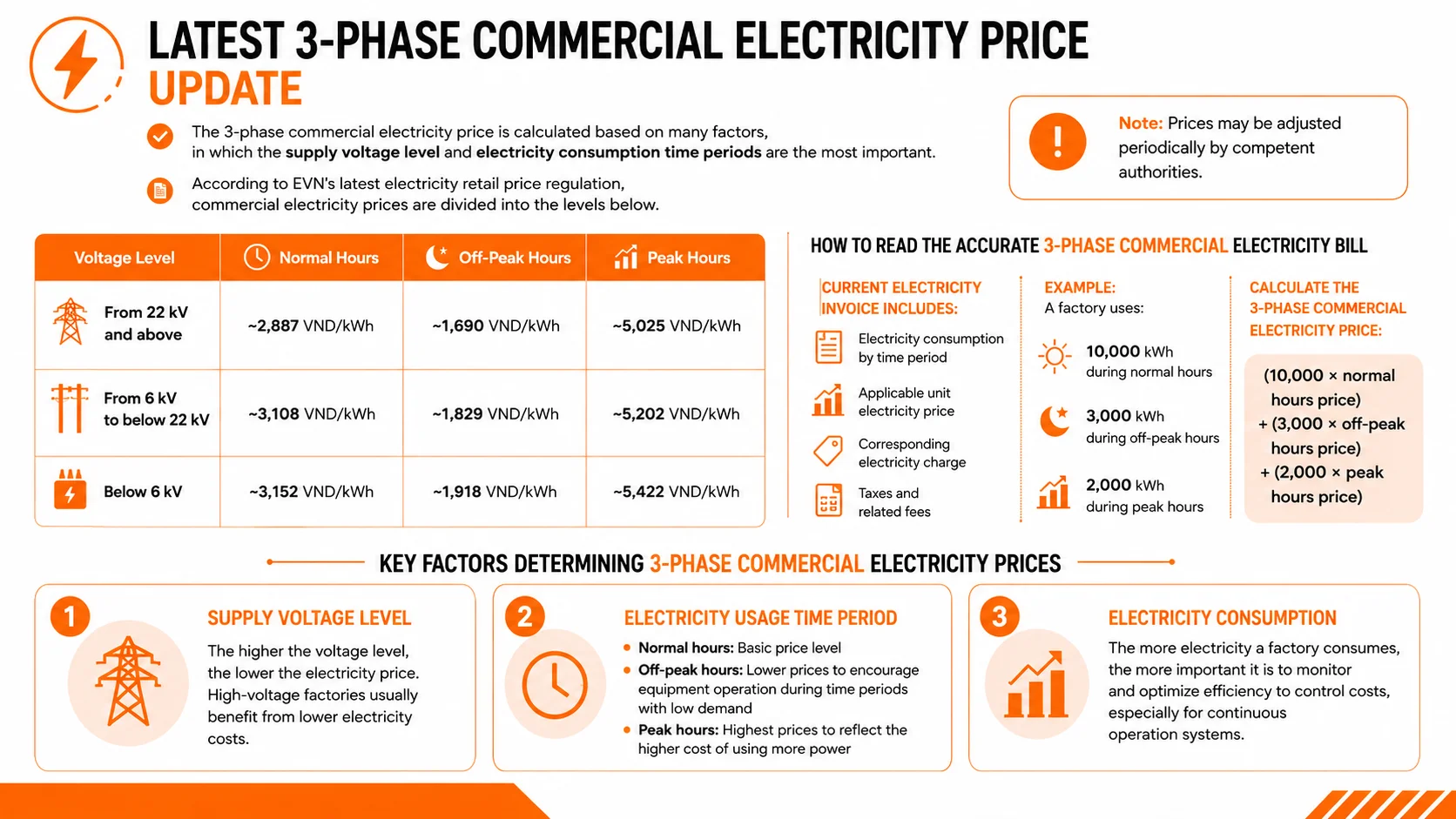

The 3-phase commercial electricity tariff in Vietnam is structured around voltage level and time-of-use billing, which means your monthly electricity bill is not fixed. It shifts based on when and how much power your facility draws. Understanding this structure is the first step toward meaningful cost control. What Is Commercial Electricity? Key Sectors That Use […]

Understanding peak electrical hours is a practical advantage for any facility manager or business owner. Knowing exactly when demand spikes allows operations teams to reschedule high-draw equipment, reduce strain on the grid, and meaningfully cut monthly energy costs over the long term. What Are Peak Electrical Hours and When Do They Occur? Peak electrical hours […]

With rising electricity costs and growing pressure to meet sustainability targets, more factories and businesses are turning to solar as a practical solution. Understanding the full pros and cons of solar energy helps decision-makers invest with clarity, not guesswork. The Key Advantages of Solar Energy for Businesses The pros and cons of solar energy are […]