1528+
MWp Capacity435+
Projects1528+
MWp Capacity435+
Projects1528+
MWp Capacity435+
Projects1528+
MWp Capacity435+
Projects
1528+
MWp Capacity435+
Projects1528+
MWp Capacity435+
Projects1528+
MWp Capacity435+
Projects1528+
MWp Capacity435+
Projects
Vietnam has significant potential to become a leading country in renewable energy development. The Government is also becoming increasingly committed to achieving its net-zero target by 2050. However, many wind power and solar power producers are currently facing several challenges and need support during the transition from fossil fuel-based energy sources to renewable energy.
Energy transition is the process of shifting electricity generation from fossil fuel resources such as coal, oil, and natural gas to renewable resources, including wind, solar, tidal energy, and biomass. Accordingly, coal-fired power plants, oil-fired power plants, and gas-fired power plants will gradually be replaced by wind power, solar power, small hydropower, and biomass energy.
This is a global trend that Vietnam is pursuing to ensure a sustainable energy supply, address current power shortages, reduce greenhouse gas emissions, protect the environment, and enhance the competitiveness of the economy. This is particularly important as many international partners increasingly require greener content in products exported from Vietnam.
In November 2021, at the 26th United Nations Climate Change Conference (COP26) held in Glasgow, Scotland, United Kingdom, Prime Minister Pham Minh Chinh committed Vietnam to achieving net-zero greenhouse gas emissions by 2050.
Among Vietnam’s many action programs demonstrating this commitment, the newly issued national power development policy serves as a clear example. Under the National Power Development Plan for the 2021 to 2030 period, with a vision to 2050 (Power Development Plan VIII), approved by the Government on May 15, 2023, renewable energy is expected to account for 67.5% to 71.5% of the power generation mix by 2050, nearly three times higher than the 26.4% recorded at the end of 2022.
According to experts, this is a highly ambitious target that requires the efforts of the entire political system, government agencies, the business community, and the public. However, several key enterprises within the renewable energy business sector are currently facing difficulties in renewable energy development.
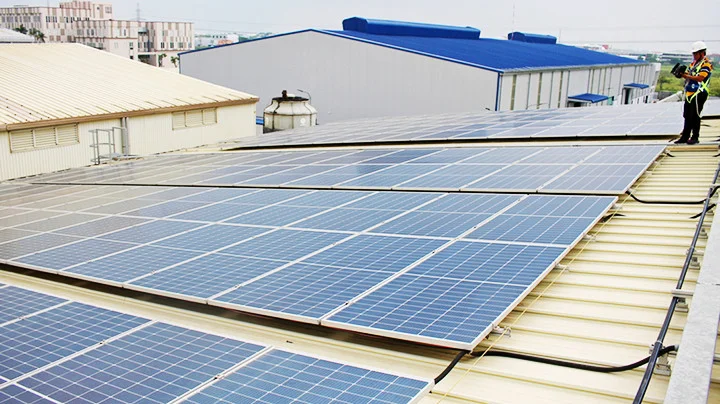
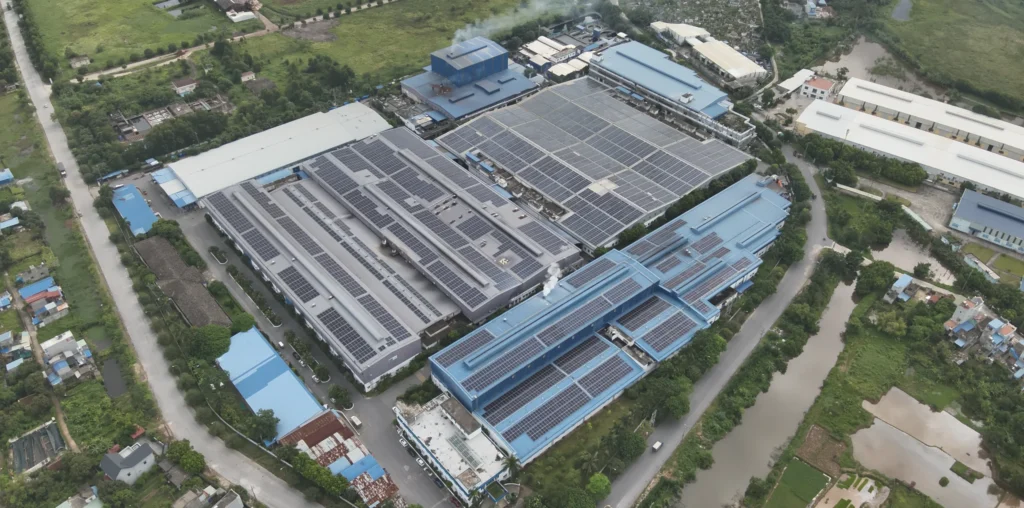
To respond to electricity shortages and rolling blackouts experienced in recent years, Kim Duc Group Joint Stock Company, a packaging manufacturer located in Vinh Loc 2 Industrial Park, Ben Luc District, Long An Province, has developed its own electricity generation capacity for production purposes. Kim Duc entered into a fixed-term partnership with Germany’s Ecoligo investment fund as the project investor and Vu Phong Energy Group Joint Stock Company as the Engineering, Procurement and Construction (EPC) contractor and Operation and Maintenance (O&M) service provider to build a self-consumption rooftop solar power system on the factory roof in 2021. Kim Duc then purchases the electricity generated by the system at a lower price than the electricity supplied by Vietnam Electricity (EVN).
According to Mr. Pham Dang An, Deputy General Director of Vu Phong Energy Group, the 2.22 MWp system generated nearly 2,600 MWh of solar electricity in 2022. This contributed approximately 12% to 13% of the Kim Duc factory’s electricity consumption and reduced around 1,900 tons of CO₂ emissions, equivalent to planting nearly 31,000 trees over a ten-year period.
Despite these significant benefits, Mr. An noted that there are currently no regulations allowing businesses to invest in rooftop solar power and sell electricity to EVN. At the same time, there are no specific regulations governing the sale of excess clean electricity between businesses without using EVN’s transmission network. This remains a major challenge for the renewable energy business environment in Vietnam.
In Quang Tri Province, a new wind power hub recently approved by the Government as a clean energy center for Central Vietnam, Mr. Nguyen Trung Thanh, General Director of Huong Hiep 1 Wind Power Plant in Huong Linh Commune, Huong Hoa District, stated that the plant has completed testing, been accepted, and achieved Commercial Operation Date (COD) status. However, it has not yet received approval for an official electricity selling price because it failed to meet the deadline for the Feed-in-Tariff (FIT) mechanism before November 1, 2021.
Speaking with reporters, Mr. Hoang Anh Son, Director of the Huong Linh 3 and Huong Linh 4 Wind Power Project Management Board, stated that Huong Linh 3 was connected to EVN’s grid on August 22 but has not yet been recognized for commercial operation and therefore cannot access the transitional tariff mechanism. Meanwhile, Huong Linh 4 has completed construction but cannot begin operation due to grid congestion.
“Relevant parties remain uncertain about how to handle projects such as Huong Linh 3 and Huong Linh 4. Meanwhile, billions of VND invested by enterprises remain idle, and the transitional tariff is lower than the production cost of wind-generated electricity,” Mr. Son said.
Mr. Ha Sy Dong, Permanent Vice Chairman of the People’s Committee of Quang Tri Province, acknowledged that both businesses and local authorities remain uncertain about several wind power projects, particularly regarding pricing mechanisms.
“Previously, the FIT mechanism was applicable until October 31, 2021, leading enterprises to race against time to qualify for FIT pricing. Quang Tri currently has more than ten unfinished projects facing serious difficulties,” Mr. Dong said, adding that the province is proposing measures to support businesses in continuing their investments and ensuring energy security.
Power Development Plan VIII identifies solar power and wind power, including both onshore and offshore wind projects, as the two primary electricity generation sources by 2050, accounting for 63% of the national power mix. Solar power is expected to contribute 34%, while wind power will account for 29%.
By contrast, coal-fired power generation will decrease from 33% in 2022 to 22% by 2030, and coal will no longer be used for electricity generation by 2050.
Wind and solar energy are also two renewable energy resources in which Vietnam holds significant advantages. In a report published in October 2023, McKinsey stated that Vietnam possesses enormous renewable energy development potential and is the most suitable country in Southeast Asia for wind and solar energy development, with a potential capacity of up to 1,000 GW.
However, McKinsey emphasized that if Vietnam does not accelerate renewable energy development, it may face a range of risks, including recurring power shortages, loss of competitiveness within global supply chains due to the growing renewable energy requirements of foreign businesses, economic impacts from carbon taxes, climate-related risks, and missed opportunities compared to neighboring countries.
According to the report, by increasing renewable energy investment in power grid infrastructure, revising and improving standard Power Purchase Agreements (PPAs), and implementing competitive bidding for new renewable energy projects, Vietnam can accelerate its net zero commitment and become Southeast Asia’s leading high-value renewable energy economy within the next decade.
Meanwhile, Dr. Nguyen Anh Tuan, former Director of the Renewable Energy Development Center under the Institute of Energy, Ministry of Industry and Trade, stated that the regulatory framework for the renewable energy business sector remains incomplete because Vietnam has not yet enacted a Renewable Energy Law. Existing Electricity Law provisions and related regulations are also insufficient to comprehensively govern renewable energy development activities.
According to Dr. Tuan, four key factors are required to facilitate renewable energy development: technology, a competitive economy, market liberalization, and supportive policies. In particular, without policy support, the transition toward renewable energy development will proceed very slowly.
More specifically, according to Mr. Nguyen Hoang Dung, Head of Renewable Energy Development Department at Power Engineering Consulting Joint Stock Company No. 3 (PECC3), in order to achieve net zero emissions by 2050, the Ministry of Industry and Trade must promptly finalize the implementation plan and submit it to the Prime Minister for approval. Once the implementation plan is approved, relevant agencies can propose specific action programs rather than waiting for regulations as they are doing today.
Providing an overall assessment, Associate Professor Dr. Ngo Tri Long, economist and former Director of the Market and Price Research Institute under the Ministry of Finance, stated that although Power Development Plan VIII has addressed the requirements of Vietnam’s power system, decisive, practical, and specific solutions are still needed to achieve its objectives. Otherwise, electricity shortages will continue to exist, while electricity prices will remain a bottleneck. Electricity pricing is one of the most important factors affecting renewable energy investment and the attractiveness of the power sector.
Under Decision No. 39/2018/QD TTg dated September 10, 2018, the FIT rate for onshore wind power was set at 8.5 US cents/kWh, equivalent to approximately VND 1,928/kWh. Offshore wind power projects were entitled to a FIT rate of 9.8 US cents/kWh, equivalent to approximately VND 2,223/kWh. This pricing mechanism was guaranteed for 20 years and applied to wind power projects achieving commercial operation before November 1, 2021.
This FIT tariff mechanism, later concluded by the Government Inspectorate to have an insufficient basis, triggered a rush of renewable energy investment as businesses sought to secure FIT eligibility before the deadline. The consequence of this rapid expansion was grid congestion, disruption of development planning, and power curtailment at many wind power plants.
On January 7, 2023, the Ministry of Industry and Trade issued Decision No. 21/QD BCT approving transitional electricity prices for certain renewable energy projects. These transitional rates are approximately 23% lower than the FIT tariff. To date, the Ministry of Industry and Trade and investors have not yet finalized negotiations on official wind power purchase prices.
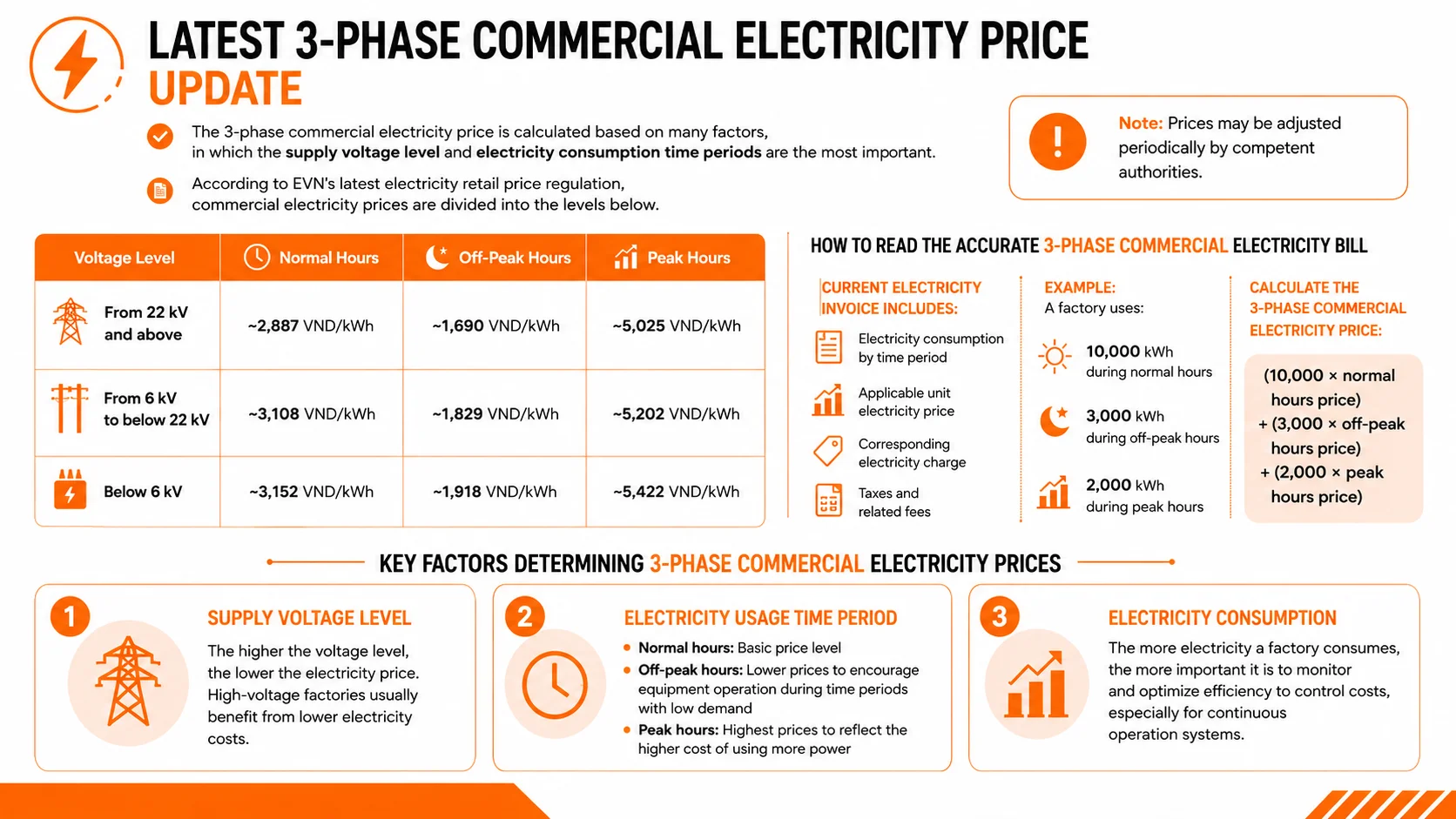

The 3-phase commercial electricity tariff in Vietnam is structured around voltage level and time-of-use billing, which means your monthly electricity bill is not fixed. It shifts based on when and how much power your facility draws. Understanding this structure is the first step toward meaningful cost control. What Is Commercial Electricity? Key Sectors That Use […]

For industrial facilities in Vietnam, electricity is one of the largest recurring operational expenses, especially for production lines running around the clock. Understanding how the Vietnam industrial electricity tariff is structured allows factory managers and asset owners to control costs, optimize production scheduling, and make informed decisions about energy investments. The short answer: your monthly […]
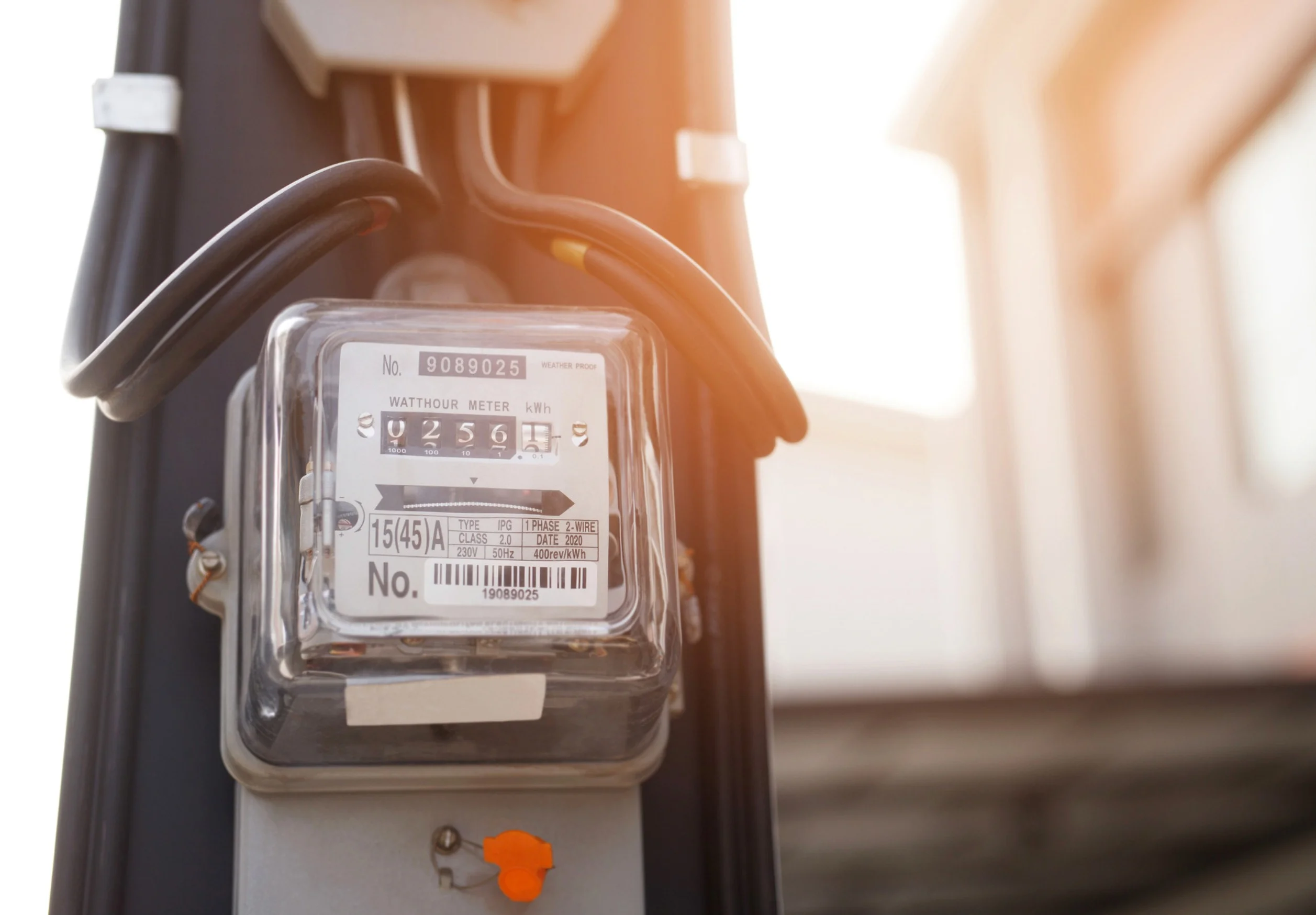
Understanding peak electrical hours is a practical advantage for any facility manager or business owner. Knowing exactly when demand spikes allows operations teams to reschedule high-draw equipment, reduce strain on the grid, and meaningfully cut monthly energy costs over the long term. What Are Peak Electrical Hours and When Do They Occur? Peak electrical hours […]