1528+
MWp Capacity435+
Projects1528+
MWp Capacity435+
Projects1528+
MWp Capacity435+
Projects1528+
MWp Capacity435+
Projects
1528+
MWp Capacity435+
Projects1528+
MWp Capacity435+
Projects1528+
MWp Capacity435+
Projects1528+
MWp Capacity435+
Projects
Managing a multi-project solar portfolio demands far more than checking whether inverters are online. For investment funds and asset owners operating commercial and utility-scale plants in Vietnam, rapid SCADA is the digital backbone that transforms raw operational data into defensible financial decisions, protecting IRR across a 20-to-25-year asset lifecycle.
Traditional monitoring setups share a critical blind spot: the absence of a fault alarm is routinely mistaken for optimal performance. In reality, a system can run silently below its design benchmark for months, accumulating yield losses that only surface during an annual financial review.
Portfolio Asset Management requires a centralized digital platform that governs all sites under a single operational framework. Rather than patching individual monitoring tools site by site, this centralized platform standardizes data collection, control logic, and reporting across an entire portfolio, enabling macro-level governance that standalone inverter software simply cannot provide.
This matters because the economic risk in solar is not just equipment failure. Chronic underperformance, even at 3-5% below baseline, compounds silently over the years and directly erodes the project’s internal rate of return.

Large solar portfolios typically combine equipment from multiple manufacturers: inverters, weather stations, transformers, and grid meters from different vendors running different communication protocols. The system resolves this fragmentation by acting as a multi-platform integration layer, aggregating data from all distributed assets into a single Control Room view.
This eliminates data gaps, one of the most damaging yet underappreciated risks in asset management. Incomplete data histories make performance verification impossible and create ambiguity when enforcing SLA annexes. When a contractor disputes an availability claim, the asset owner needs continuous, timestamped operational logs to back their position. The system provides exactly that audit trail.
Key data centralization functions include:
Raw data displayed in real time has limited value on its own. The economic contribution of the platform comes from transforming that data stream into trend analysis and comparative performance benchmarking. By establishing a performance baseline calibrated to each site’s actual irradiance conditions, the system enables cross-portfolio comparison between plants operating under similar solar resource conditions.
This baseline concept is fundamental to the asset management discipline. Without a platform-derived baseline, owners cannot distinguish between underperformance caused by equipment degradation versus a temporary dip due to low irradiance. That distinction determines whether a maintenance dispatch is justified and who bears the associated cost.

The conventional reactive maintenance model (fixing equipment after it fails) introduces uncontrolled downtime and unpredictable OPEX spikes. Professional solar O&M services integrated with rapid SCADA enable a shift from time-based maintenance schedules to condition-based maintenance driven by actual equipment state data.
This transition has a measurable financial impact:
Recurring short-duration downtime events are among the largest hidden causes of generation loss in operating solar plants. A single inverter restarting three times per week may not trigger a major alarm, but the aggregated yield impact across a multi-MW portfolio is material.
The SCADA system automatically detects, logs, and classifies these micro-downtime events. This continuous monitoring ensures that critical operational KPIs, including Performance Ratio (PR), system availability, and cumulative downtime hours remain within the thresholds defined in the O&M contract.
Maintaining these metrics is not just an operational goal; it is a contractual obligation with direct financial consequences for the O&M provider.

O&M contracts impose strict requirements on response time and fault resolution, categorized by impact severity. Measuring these obligations manually is unreliable and creates dispute exposure. The platform digitizes the entire SLA measurement process by automatically logging alarm triggers, response timestamps, and resolution confirmations, creating an immutable operational record.
This data infrastructure enables asset owners and O&M providers to agree on a Minimum Service Level defined by availability metrics rather than absolute generation guarantees, which are inherently weather-dependent. Setting availability-based SLAs backed by this data is a more defensible and equitable contractual framework for both parties.
When disputes do arise, reports extracted from rapid SCADA serve as the quantitative evidence base for Root Cause Analysis. Responsibility can be allocated precisely: equipment failure versus maintenance delay, or force majeure. This clarity removes the ambiguity that typically drives legal costs in O&M disputes.
Undetected and unmanaged system degradation increases the levelized cost of energy (LCOE) over time, directly compressing project IRR. Operating at “electrically safe” status is a regulatory minimum, not a financial performance standard. For investment funds managing solar assets, the distinction is critical.
The core mandate of Solar Asset Management is to apply technology to continuously optimize operational performance and minimize cumulative yield losses across annual cycles. Portfolios that operate without a centralized architecture are, in effect, managing their most valuable long-duration assets blind. The data exists inside the equipment; the question is whether it is being captured, structured, and acted upon systematically.
Rapid SCADA converts a passive monitoring role into an active asset control function: accountable, data-driven, and aligned with the long-term financial model of each project in the portfolio.

Electric Bird provides international-standard Solar O&M and Asset Management services for investment funds and enterprises operating solar portfolios in Vietnam. Our services are built on advanced rapid SCADA integration, delivering continuous KPI monitoring, seasonal performance trend analysis, and early fault diagnostics aligned to your asset management objectives.
Contact Electric Bird today to build a comprehensive O&M digitization strategy for your solar portfolio.
Inverter-bundled software monitors only that device in real time. Rapid SCADA covers all system components across multiple plants simultaneously, stores full historical data for performance analysis, and supports remote control functions.
A baseline defines the expected performance level calibrated to actual site conditions. Without it, owners cannot distinguish equipment-driven underperformance from irradiance-driven variation, making maintenance decisions speculative rather than data-driven.
Yes. Operational logs from the system, including event logs, alarm timestamps, and environmental parameters, serve as quantitative evidence for calculating Availability, Response Time compliance, and SLA compensation obligations.
Yes. It functions as a multi-vendor integration platform, communicating with devices across different protocols to deliver a unified portfolio view from a single Control Room.
By detecting underperformance early, enabling condition-based maintenance, and providing continuous visibility into KPIs like PR and availability, it prevents the slow yield erosion that compounds into significant IRR impact over a 20-to-25-year asset life.
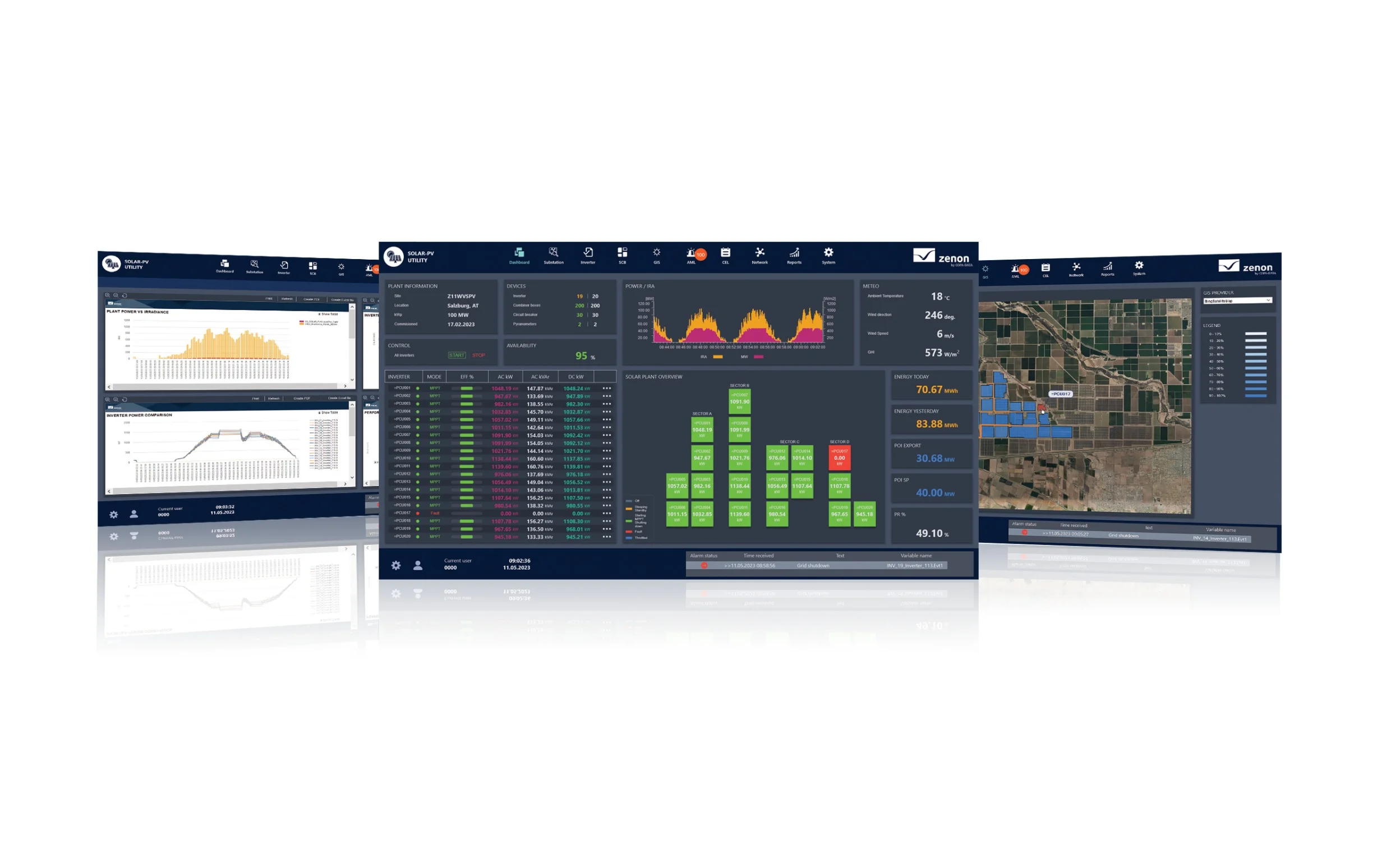

During the investment and operation of solar power plants, many businesses confuse monitoring with SCADA. While both serve the purpose of system oversight, these two platforms differ significantly in terms of functionality, control capabilities, and operational support. For large-scale projects in particular, understanding the role of SCADA in a solar power system helps investors optimize […]

In the digital energy era, managing a solar power plant goes far beyond reading basic performance metrics. An AI-integrated SCADA control system shifts the entire operational model from passive data collection to active predictive intelligence, giving asset owners a decisive edge in protecting long-term returns. From Reactive Monitoring to Predictive Intelligence Most conventional SCADA control […]

Most solar panel businesses reach commercial operation and immediately shift focus to the next project. The system is running, the inverters are green, and the monthly report shows output. But here is the uncomfortable reality: a system can appear operational while silently losing 5 to 15 percent of its annual yield, and the owner never […]