Why a Service Level Agreement (SLA) Matters in Every Solar O&M Contract

A service level agreement is the contractual document that defines measurable service standards, performance thresholds, and response time commitments that an O&M provider must meet throughout the operational life of a solar asset. Once a project passes its Commercial Operation Date (COD), the SLA stops being a formality and becomes the single most important risk management tool you have.
How a Service Level Agreement Shapes Solar O&M Quality
After COD, the SLA is the only binding measure of O&M performance
Before COD, project attention typically centers on EPC milestones, construction timelines, and technical commissioning. The moment the plant goes live, all operational risk shifts to the O&M phase, and that is where a well-drafted service level agreement proves its worth.
At this stage, the SLA functions on three levels:
- Measurement framework: It quantifies service quality with defined metrics rather than vague commitments.
- Performance benchmark: It gives asset owners an objective basis for evaluating whether their O&M provider is actually delivering.
- Risk control mechanism: It ensures faults are resolved within agreed timeframes, directly protecting revenue generation.
Without a clear SLA, assessing maintenance quality becomes subjective, and disputes become almost inevitable.

Closing the gap between financial models and operational reality
Financial models built at project inception are, by nature, optimistic. Real-world operations introduce degradation, soiling losses, weather variability, and human error. A properly structured service level agreement acknowledges this gap and defines acceptable performance boundaries, giving both parties a shared reference point for what “good operations” actually means.
This alignment is especially critical for asset owners managing multiple sites or long-term debt obligations tied to energy yield projections.
Key SLA Metrics and What They Actually Mean for Your Asset
Understanding how to define SLA metrics is where many O&M contracts fall short. Here is what experienced operators focus on.
Performance Ratio (PR)
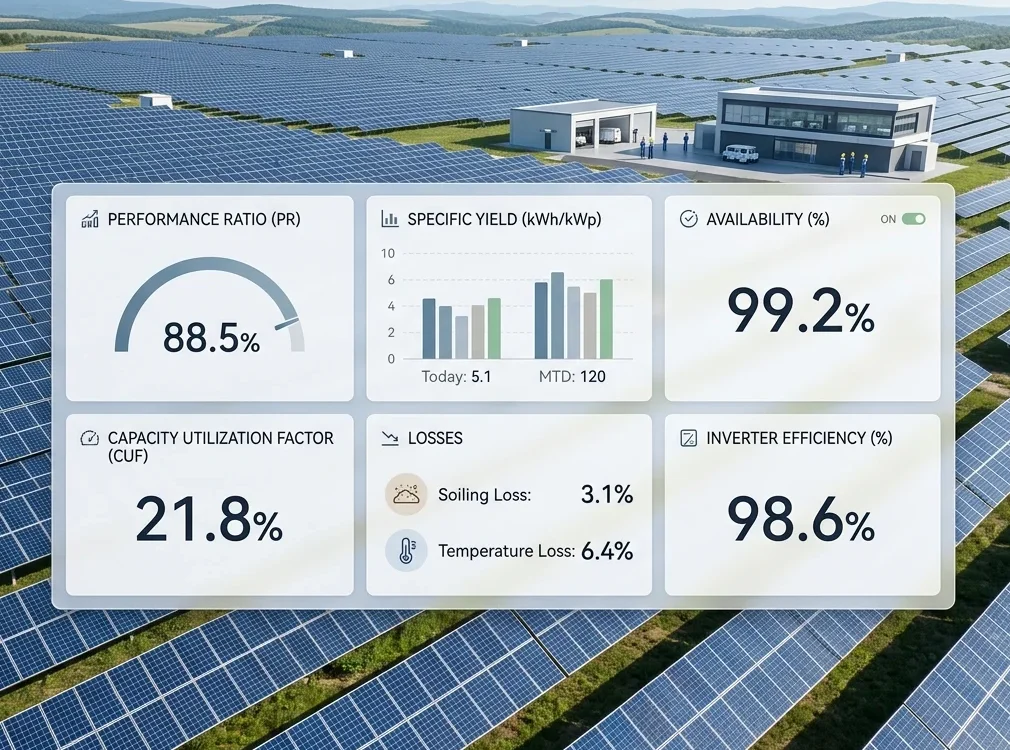
PR measures the technical quality of system output relative to available irradiation. A drop in yield due to weather is expected. A drop in PR, however, signals a technical or operational failure. Within a service level agreement, PR commitments need:
- A clearly defined calculation methodology
- A verified irradiation data source
- An explicit force majeure exclusion clause
System Availability
Availability measures the percentage of daylight hours during which the system is in a ready-to-generate state. A professional O&M provider does not just commit to a percentage figure; they ensure the system is never offline during peak irradiance hours (typically 11:00–13:00), which is when the asset generates its highest revenue per hour.
A vague availability clause without a defined calculation scope is a common source of disputes. A robust SLA specifies:
- The precise measurement window
- Planned maintenance exclusions
- How repeated downtime events are handled
Response Time
In commercial and industrial (C&I) rooftop projects, every hour of unresolved downtime directly reduces electricity cost savings. Response time commitments should clearly distinguish between:
- Time to acknowledge the fault
- Time to arrive on site
- Time to implement a temporary fix
Applying the same response time to a critical inverter fault and a routine sensor error is a structural weakness in any SLA. Tiered severity classifications avoid this problem.
The checklist for an effective service level agreement
Before signing any Solar O&M contract, confirm the SLA covers:
- System availability commitment above 98%
- Fault response time of 2–4 hours for critical events
- Seasonal PR targets with agreed calculation methodology
- Defined penalty and incentive structures tied to measurable outcomes
- Owner’s right to independently verify and audit performance data

What Happens When Solar O&M Contracts Lack a Clear SLA
From Electric Bird’s experience working across solar projects in Vietnam, the consequences of weak or absent SLA clauses follow a predictable pattern.
- Prolonged fault resolution leading to yield loss: Without a binding response time clause, a minor inverter fault can remain unresolved for days. On larger systems, each hour of unplanned downtime translates directly into measurable revenue loss.
- Blurred accountability between parties: When performance degrades, an O&M provider may attribute the cause to equipment quality while the asset owner attributes it to poor maintenance. Without SLA data as the reference, technical discussions become arguments, and resolution timelines extend significantly.
- Compounding risk over a 20–25 year asset life: Contract dispute costs over a project’s operational lifetime can far exceed the initial investment required to draft a properly structured SLA. Most disputes center on performance, downtime duration, and remediation obligations.
- Reactive rather than controlled operations: No SLA means no formal prioritization framework. Without structured response protocols, maintenance becomes reactive and ad hoc. The result is gradual, undetected yield degradation, rising O&M costs over time, and no early warning mechanism.
Building an SLA That Reflects Real-World Project Risk
Not all solar assets carry the same operational risk profile
A rooftop C&I installation and a utility-scale solar farm are fundamentally different in terms of scale, site access, environmental conditions, downtime exposure, and technical complexity. Applying a generic SLA template across both project types introduces blind spots in risk management.
Effective SLA management begins with calibrating commitments to actual site conditions, realistic access constraints, and the operational risk profile specific to that asset class. An SLA designed for a ground-mounted rural solar farm may be entirely unsuitable for an urban rooftop system with restricted access windows.
SLA effectiveness depends on data integrity
The core principle of asset management applies directly here: you cannot manage what you cannot measure. A service level agreement only has practical value when it is backed by verifiable operational data, regular reporting cycles, and a clear audit mechanism.
Data also serves a broader purpose beyond compliance checking. Longitudinal performance records enable trend analysis, support early identification of degradation patterns, and allow O&M strategy adjustments before minor issues become costly failures.

Electric Bird’s Perspective on SLA in Long-Term Solar Operations
A well-structured service level agreement does not guarantee a perfectly performing system. What it does guarantee is that the operations team is not performing incorrectly. It sets behavior norms, establishes priority frameworks, and, most importantly, protects the asset over its full operational life.
When both parties agree on how to calculate PR, availability, and downtime, three things consistently follow: technical disagreements decrease, decisions become data-driven, and the O&M relationship evolves into a genuine operational partnership rather than a transactional service arrangement.
This shift from vendor to strategic partner is what separates short-term contract relationships from durable, performance-aligned engagements that genuinely protect asset value across decades.
Conclusion
In the O&M phase of a solar project, a service level agreement is not an administrative formality. It is a core asset management tool that defines accountability, enables data-driven decision-making, and protects revenue over a 20–25 year operational horizon. Getting the SLA structure right from the outset is one of the highest-return investments an asset owner can make.
If you are evaluating O&M providers or reviewing an existing contract structure, Electric Bird’s Solar O&M team works with asset owners to design service level agreements that are measurable, enforceable, and aligned with real operational conditions.
Get in touch with Electric Bird for a detailed consultation.
FAQ: Service Level Agreement in Solar O&M
What is a service level agreement in the context of solar O&M?
It is a contractual annex that defines the measurable performance commitments, response standards, and operational benchmarks an O&M provider is legally required to meet throughout the solar asset’s operational period.
Does an SLA guarantee a specific energy yield?
No. A service level agreement does not guarantee absolute yield, as energy output is influenced by irradiation and weather that are outside operational control. What it does is define the minimum acceptable operational quality and limit the risk of avoidable yield loss.
How does SLA management differ between rooftop C&I and solar farm projects?
Rooftop C&I systems often have restricted site access, closer integration with occupant operations, and different downtime cost profiles. Solar farms typically require faster response thresholds for large-scale faults. Effective SLA management tailors commitments to each asset’s specific risk exposure rather than applying a uniform standard.
How often should an SLA be reviewed?
Best practice is to review the service level agreement annually or whenever there is a material change in operational conditions, such as equipment upgrades, environmental changes, or ownership transitions.
Can I verify SLA compliance independently as an asset owner?
Yes, and you should. A professionally structured SLA includes explicit provisions granting the asset owner access to raw performance data, third-party audit rights, and regular reporting in a standardized format. If a proposed SLA does not include these provisions, that is a red flag worth addressing before signing.