Solar Panel Maintenance: 7 Issues That Cut Energy Yield & How To Fix
There is a situation many solar project operators know well: the monitoring dashboard looks normal, the inverter shows no critical faults, and energy is being generated every day, yet actual revenue consistently falls short of the original financial model.
That gap rarely comes from a single major failure. It builds from dozens of small operational decisions, each shaving off a fraction of a percent from daily yield, compounding quietly into a meaningful shortfall over the years.
This article breaks down the 7 most common solar panel maintenance failures in real-world O&M programs, explains why they erode long-term performance, and outlines the practical fixes that protect your asset’s energy yield.
How Standard O&M Misses the Real Problem
A typical O&M routine for a solar system covers the basics:
- Check inverter status
- Confirm no active fault alerts
- Log end-of-day energy output
This approach answers one question: “Is the system running?” It cannot answer the more important one: “Is this solar system performing at its optimal capacity?”
Modern solar O&M is not about confirming uptime. It is about tracking performance trends over time. A system that never faults can still operate 10 to 15 percent below its potential for months before anyone notices.
Degradation of 5 to 20 percent per year rarely comes from dramatic failures. It accumulates through minor string imbalances, incremental drops in Performance Ratio, and short untracked downtime events. Without a performance baseline from year one, there is no way to distinguish natural module aging (typically 0.5 to 0.7 percent per year) from operational losses that are entirely preventable.
Issue 1: No Long-Term Performance Degradation Tracking
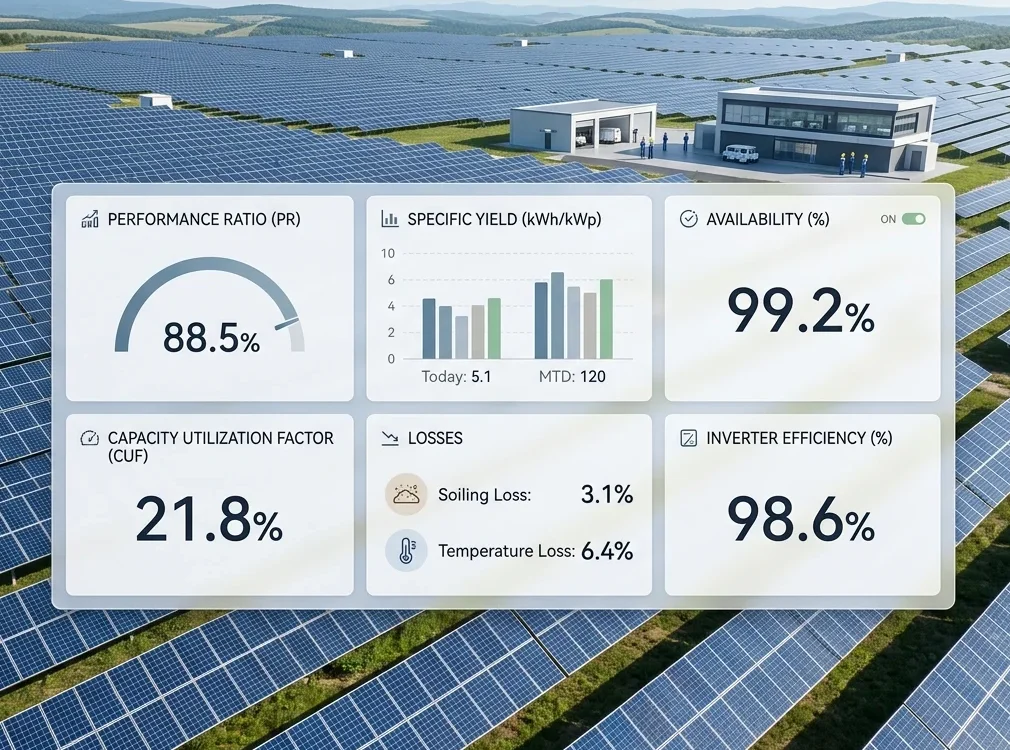
Many projects monitor absolute kWh output but nothing else. Without tracking Performance Ratio, specific yield (kWh/kWp), and year-over-year comparisons, there is no meaningful way to tell whether the system is healthy.
When there is no baseline from the first year of operation, a 6 percent degradation looks identical to normal aging on a dashboard that only shows total generation.
Recommended fix: Build a performance baseline and monitor against it
From commissioning, set up the metrics that will matter throughout the asset’s lifetime:
- Track PR and specific yield monthly and annually
- Compare performance against the same period in prior years, not day-to-day figures
- Set degradation thresholds that trigger review when decline outpaces natural aging
This is the foundation of professional solar panel maintenance, and without it, every other O&M action is essentially reactive guesswork.
Issue 2: Panel Inspections Disconnected from O&M Strategy
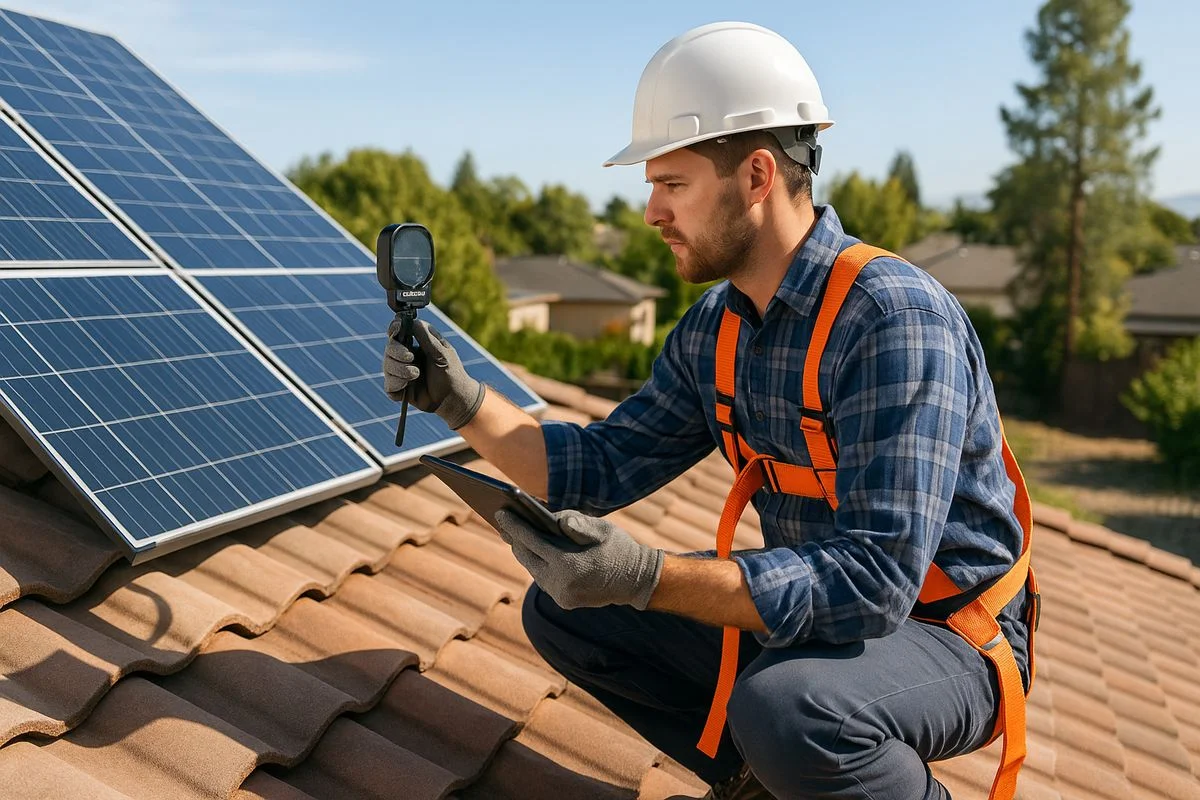
Visual inspections are still common on many sites. They can catch broken glass or heavy soiling, but they miss the issues that actually cost yield: hotspots, micro-cracks, and cell-level degradation.
These can only be identified through thermal imaging and IV-curve analysis. Running these tools without a systematic, risk-prioritized schedule produces data that never gets acted on.
Recommended fix: Risk-based inspection scheduling
Not every panel carries the same risk at any given time. An effective solar panel maintenance inspection program prioritizes based on operating history and known problem zones:
- Apply detailed thermal and IV analysis to panels in areas with a history of underperformance
- Combine visual checks, operational data review, and thermal camera results into one assessment
- Maintain a condition record for each panel over time; inspections should build a picture, not produce isolated reports
This is how experienced O&M teams find hidden faults before they become revenue losses. PV repair decisions made from incomplete inspection data often address the wrong panels first.
Issue 3: Cleaning Schedules Based on Calendar, Not Data
Cleaning panels more frequently does not automatically mean better yield. Washing at the wrong time causes thermal shock to hot glass. Washing too often raises costs without proportional production recovery.
The correct approach is to treat cleaning as an economic decision: when does the revenue recovery from cleaning outweigh the cost of doing it?
Recommended fix: Data-driven soiling loss analysis
Replace fixed cleaning schedules with a threshold-based approach:
- Monitor production loss attributed to soiling in real time
- Compare the cost of a cleaning cycle against the estimated yield recovery
- Adjust cleaning frequency by season and local environmental conditions
In many climates, the optimal cleaning interval shifts between dry and wet seasons by several weeks. A static monthly schedule will either over-clean in rainy periods or under-clean during dust accumulation events. Proper solar panel maintenance means adapting the cleaning cycle to what the data actually shows.

Issue 4: String Imbalance and Inverter Drift Left Unmonitored
Inverter-level output monitoring is not enough. A single string degrading at 8 to 10 percent will drag down the performance of an entire inverter without triggering a fault alarm. The data is there, but it requires string-level analysis to see it.
Recommended fix: Periodic string and inverter data analysis
Practical steps:
- Compare the current output across all strings on the same inverter
- Track performance deviation between strings over time
- Intervene with reconfiguration when deviation crosses the acceptable threshold
This is a standard step in professional PV repair programs. Catching string drift early means a site visit and a wiring adjustment, not a full inverter replacement.
Issue 5: Shading Changes Are Never Re-Evaluated
Shading analysis at the design stage is a snapshot, not a permanent truth. After two to three years, the environment around the array changes:
- Trees grow and extend shadow lines across previously clear rows
- Adjacent buildings expand or add new structures
- Additional equipment is installed on or near the array
If shading is not reassessed periodically, a system that was shadow-free at commissioning may be losing 5 to 8 percent of annual yield to new obstructions.
Recommended fix: Annual shading review as part of O&M scope
Incorporate shading assessment into the annual maintenance cycle:
- Document vegetation growth and new construction around the array
- Identify strings with increasing shading-related losses in production data
- Adjust layout or apply mitigation measures such as optimizer installation on affected strings
Issue 6: Slow Alert Response: A Costly Solar O&M Habit
Not every alert is critical. But every alert needs to be classified and acted on within a defined timeframe. Without an internal SLA for alert response, a pattern forms:
- Repeated low-severity alerts get ignored
- Short downtime events accumulate untracked
- Yield losses are never quantified until they show up in the annual financial review
Recommended fix: Tiered alert response with defined SLAs
Structure alert management by impact on production:
- Classify each alert type by its potential effect on daily and annual yield
- Assign a maximum response time for each category
- Review recurring alerts monthly to identify systemic issues
A clear escalation protocol is what separates a reactive maintenance team from one that actively protects asset performance.
Issue 7: No Long-Term O&M Strategy Built Into the Project
Many projects optimize for upfront capital costs and treat O&M as a budget line to minimize. After three to five years, repair costs and yield losses begin to rise sharply, and there is no plan in place to manage them.
A strong solar panel maintenance strategy needs to be designed alongside the technical system, not added later as an afterthought.
After year five, systems without a long-term O&M plan typically face:
- Unplanned inverter replacements outside the financial model
- Accelerated asset degradation beyond warranty assumptions
- Escalating PV repair costs that compress project IRR
Recommended fix: Design O&M for the full asset lifecycle
Treat O&M as a financial instrument, not a cost center:
- Build an O&M plan that covers the full 20 to 25-year system lifecycle
- Budget for scheduled maintenance, planned upgrades, and equipment replacement cycles
- Review O&M performance annually and adjust strategy based on actual vs. modeled yield
At Electric Bird, this is the core of how we approach long-term asset management: O&M is not what you do when something breaks. It is the ongoing discipline that determines whether the project delivers its projected returns.
Summary: Effective Solar Panel Maintenance Starts with Smart O&M
The yield losses that matter most in a solar project are rarely the dramatic ones. They are the quiet ones: small misalignments in operations that accumulate over years and eventually show up as a meaningful gap between modeled and actual revenue.
Each of the seven issues above follows the same pattern: a manageable problem that gets ignored until it becomes an expensive one. The common thread is the absence of structured solar panel maintenance that tracks the right metrics, responds at the right speed, and plans across the right timeframe.
From Electric Bird’s perspective, effective O&M is not about doing more. It is about measuring the right things, at the right time, with the right priorities.

If you are evaluating your current approach or planning O&M for a new project, Electric Bird offers specialized solar panel maintenance and asset management services designed to protect long-term energy yield and project IRR.
Reach out to our team to discuss a program built for your system’s full lifecycle.
Frequently Answers and Questions about Solar Panel Maintenance
Should I hire a specialized company for solar panel maintenance?
For mid-to-large-scale systems, yes. A dedicated O&M provider brings the monitoring infrastructure, inspection tools, and technical protocols to maintain performance at a level that in-house teams typically cannot match without significant investment.
What does solar O&M actually include?
Solar O&M covers all activities required to keep a PV system operating safely and efficiently: performance monitoring, scheduled inspections, cleaning, fault management, inverter servicing, and long-term asset reporting.
How often should solar panels be cleaned?
There is no universal answer. Optimal cleaning frequency depends on soiling loss data, local environment, and the cost-benefit calculation for your specific site. Data-driven threshold scheduling consistently outperforms fixed-interval approaches.
Is solar panel maintenance expensive?
Structured maintenance costs are almost always lower than the cumulative yield losses from unmanaged degradation. The real cost comparison is between a planned O&M budget and the unplanned costs of reactive PV repair after years of deferred maintenance.
What is the most common cause of long-term yield loss in solar systems?
In systems with quality equipment installed to spec, the leading cause of long-term underperformance is operational: no performance baseline, no string-level monitoring, and no proactive response to early indicators of degradation.